
How to Check Criminal History in Bosque County
Bosque County has no single public search that joins arrest reports, bookings, court filings, and Texas conviction data. Start by defining the event. A felony case belongs with the District Clerk. A sheriff arrest or booking question belongs with the Bosque County Sheriff’s Office. A city police report stays with that city department, while a Class C citation may remain in a municipal or justice court. The District Clerk’s search instructions show how to request a name search or copies when a case number is not known.
Gather the full name, date of birth, approximate event date, city, arresting agency, and any cause or incident number. Spellings and aliases matter. A name-only match is not proof of identity, so compare dates and the agency before relying on it. Use the following sequence to trace a Bosque County criminal record from its source to its later outcome.
- Identify whether the source event was an arrest, court filing, city citation, or state custody event.
- Ask the creating office for its report, booking entry, or case number.
- Search the District Clerk or relevant lower court for filed charges and disposition.
- Compare the local result with the DPS public conviction search when statewide reporting matters.
- Order a certified court copy or fingerprint self-review when identity and official proof are important.
Bosque County Criminal Record Chain
The most common search mistake is treating one result as the whole history. An arresting agency starts the offense and arrest report. The Bosque County Jail creates custody, charge, photograph, and fingerprint data at book-in. A magistrate handles the first appearance and bond. Prosecutors decide what to file, and the District Clerk then keeps the 220th Judicial District Court case. Clerks and custody agencies report later events to DPS. Each source has a different job and can show facts another source omits.
A booking can exist even when prosecutors file no charge. A court file may include motions and a final judgment that the public DPS result does not display. Reporting delay, missing fingerprints, aliases, or an unreported disposition can also cause gaps. For that reason, confirm the event with its originating office and then follow it forward.
Official Texas Background Checks
The Texas Department of Public Safety Crime Records Division maintains the central computerized criminal-history repository. Any member of the public can create an account for the DPS Criminal History Conviction Name Search. The public product covers convictions and deferred adjudications reported to DPS. It is not a guaranteed complete arrest history. One search credit costs $1. Credit-card purchases add 2.25 percent plus $0.25 per transaction, while an offline DPS name check costs $10.
For review of your own Texas record, fingerprints reduce the risk of a false name match. Texas Fingerprint Applicant Services of Texas uses IdentoGO by IDEMIA. DPS lists a $15 personal record-review fee plus a $10 FAST fingerprint charge. Schedule through the official enrollment site or call 1-888-467-2080. The state channel supplements Bosque County court and sheriff records; it does not replace them.
Bosque County DPS Record Search
The DPS name search works best when the searcher supplies more than a surname. Search credits are spent on queries, so careful input can reduce weak matches. DPS also advises users to inspect the matching identifiers and the reporting agency. A public result is limited to material Texas law allows DPS to release.
| Search field | How it helps |
|---|---|
| Last and first name | Required name elements; try known spelling variants with care. |
| Middle name | Helps narrow people who share common names. |
| Date of birth | Provides a stronger identity check than a name alone. |
| Sex and race | Additional filters for separating similar results. |
The official DPS explanation of the service is also the source for its scope and credit rules.
The official interface makes clear why a DPS result is a state repository check, not a substitute for the full court file in Meridian.
Types of Bosque County Criminal Records
“Criminal record” can mean several documents made at different stages. The source controls what the record says and how it can be obtained. In Bosque County, police and the Sheriff create incident and arrest reports. The jail records booking and custody. Courts keep filings and judgments. DPS compiles reportable statewide history, and TDCJ holds state prison and supervision data.
Pick the record that answers the question instead of ordering everything. An arrest report describes the event from the agency’s view. A judgment proves the court’s final result. A warrant inquiry concerns current authority to arrest and follows a stricter local route.
- Arrest and booking records describe custody, the booked charge, and release or bond details.
- Criminal court files hold pleadings, docket events, orders, disposition, and sentence.
- DPS history compiles reportable Texas convictions and deferred adjudications.
- Warrants are checked through the issuing court or the Sheriff’s in-person process.
- Supervision and registry records come from local CSCD, TDCJ, and the Texas registry.
Bosque County Sheriff Record Requests
The Sheriff’s records page expressly accepts public requests for cases and arrests. Complete its linked Public Information Request form and describe the exact report, arrest, booking, date, place, and involved name when known. The Sheriff may withhold or redact active-investigation material, confidential information, and records covered by a statutory exception. Some material may become available after an investigation is no longer active.
The county’s public information instructions explain the written request path and cost-estimate process.
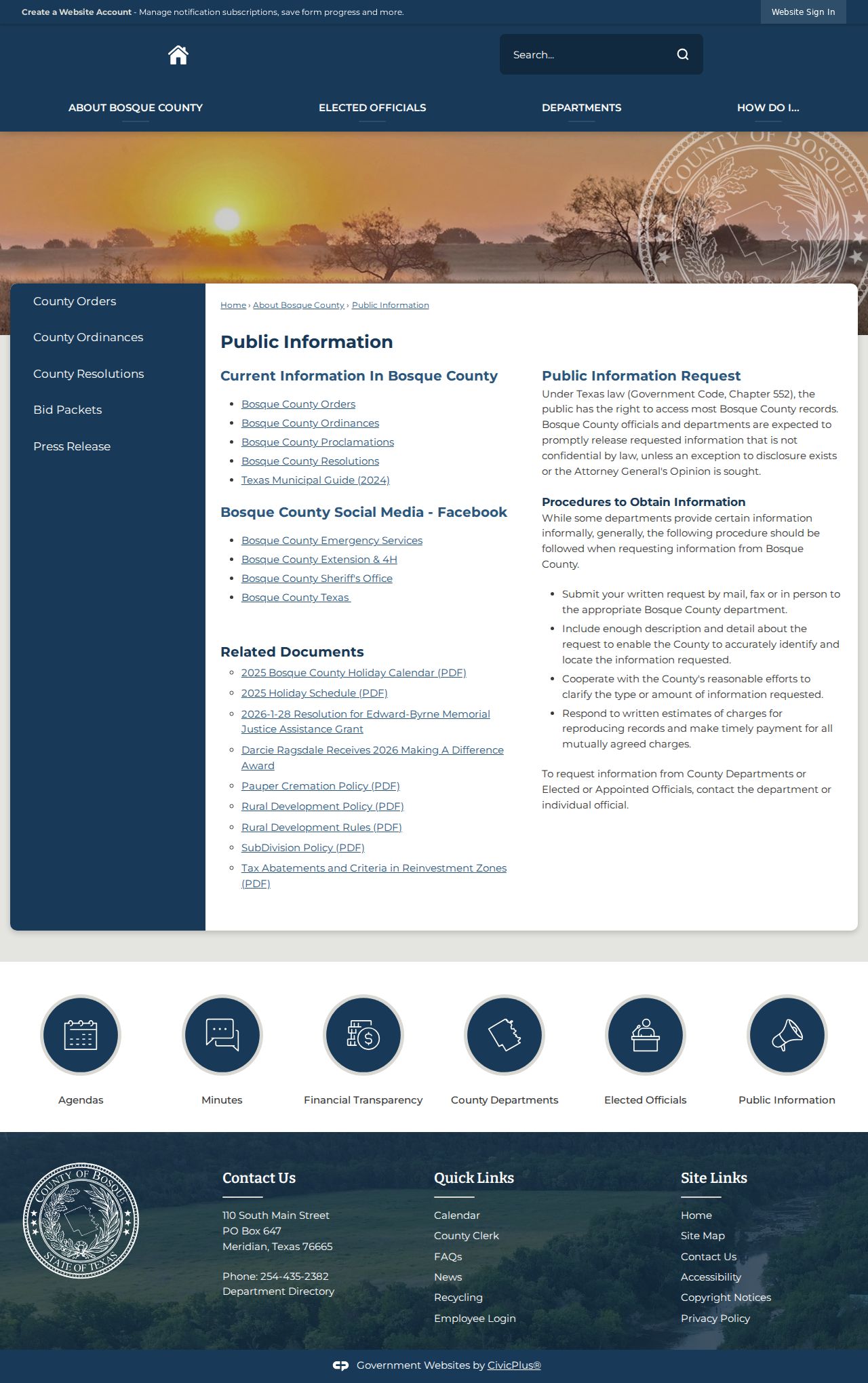
This county page is the broader official fallback when a department has no dedicated online records portal.
Bosque County Sheriff’s Office
266 FM 2840, Meridian, TX 76665
Records questions: 254-435-2362 or 254-435-2363
Detention and Booking: 254-435-9966
Written county requests may be delivered to the department that holds the record by mail, fax, or in person. No Sheriff fee schedule, certified-copy charge, ordinary processing time, or countywide email method was found in the official sources. Ask for an estimate rather than assuming the record is free.
What a Bosque County Criminal Record Shows
The fields depend on the stage and custodian. A jail booking lists the accusation recorded at intake, not a final finding. The District Clerk’s file can show a cause number beginning with “CR,” the setting, attorney, filed charge, motions, plea, judgment, and sentence. DPS may show reported arrests tied to fingerprints and a later disposition. Read the source label and date before comparing two entries.
| Name & Identifiers | Name, birth date, aliases, and agency identifiers where public. |
|---|---|
| Arrest / Booking Data | Arrest date, booking date, arresting agency, booked charge, bond, and release data. |
| Charges & Statutes | The alleged offense and cited Texas law, which may change after prosecutor review. |
| Disposition | Dismissal, plea, deferred adjudication, acquittal, or conviction recorded by the court. |
| Sentence | Custody, fine, or community-supervision terms ordered in the judgment. |
| Custody / Supervision Status | County custody, TDCJ confinement, parole, or community supervision when applicable. |
Bosque County Booking Record Fallback
Bosque County does not provide an official public jail roster or booking search. For current custody, call Detention and Booking at 254-435-9966. For a report or older booking material, use the Sheriff’s written records process. The official jail page describes the 64-bed Law Enforcement Center and a booking process that includes intake, medical screening, classification, and magistration within 24 hours as the county describes it.
The jail page confirms the phone fallback and process, but it does not expose a name-search interface.
Do not start with the TDCJ Inmate Information Search for a recent Bosque booking. TDCJ covers state custody and supervision, not the county jail. After a state sentence, the TDCJ locator can become the right source.
Public Access Laws for Bosque County Criminal Records
The Texas Public Information Act gives the public a process to request government records, but it does not make every criminal-history detail open. Court records also follow judicial access rules. Texas Government Code Chapter 411 controls criminal-history dissemination, while specific laws restrict juvenile files, sealed material, and protected personal data. A Bosque County office may seek an Attorney General decision when it believes responsive material must be withheld.
Key Statutes:
Government Code Chapter 552 gives the public its request process and defines exceptions.
Government Code Chapter 411 governs access to and release of Texas criminal-history information.
Code of Criminal Procedure Chapter 55A governs expunction under the current law.
Code of Criminal Procedure Chapter 62 sets sex-offender registration and public registry rules.
Bosque County Warrant Record Rule
The Bosque County Sheriff does not disclose warrant information by telephone. Its official warrant instructions require an in-person inquiry with valid identification at the Law Enforcement Center. That rule differs from custody questions, which the Booking line handles by phone. Do not confuse the two routes.
The instructions show why a general call to the Sheriff cannot confirm an active warrant. A bench warrant issued in a filed case may also be reflected at the court that issued it. City warrants should be checked with the relevant municipal court.
If a warrant may concern you, use the official channel and address it through the issuing court or counsel. The Sheriff’s most-wanted page is selective, warns against confrontation, and is not a complete warrant list.
Sealed, Expunged & Restricted
Texas now places expunction chiefly in Code of Criminal Procedure Chapter 55A, effective January 1, 2025. An expunction can require agencies to destroy or return eligible records under a court order. An order of nondisclosure under Government Code Chapter 411 is different: it limits public disclosure of eligible history but does not erase the record for every authorized agency. Eligibility depends on the case and statute, so a missing public result alone does not prove either form of relief.
Juvenile records and information protected by law follow separate access rules. When a disposition is missing or wrong, compare the certified Bosque County judgment with the DPS entry. DPS provides a challenge process for a person reviewing their own record. Correcting an error is not the same as seeking expunction or nondisclosure.
Bosque County Court Record History
The physical setting explains why many older records still route through Meridian. Bosque County began business in an 1854 log structure. After an 1869 frame courthouse burned in 1871, county officials worked from a tent for four years. The present limestone courthouse was completed in 1886. Later work removed its tower and roof, and the 2005 to 2007 restoration rebuilt the tower, turrets, doors, windows, halls, courtroom, and wainscot.
The Texas Historical Commission’s courthouse account documents that restoration.
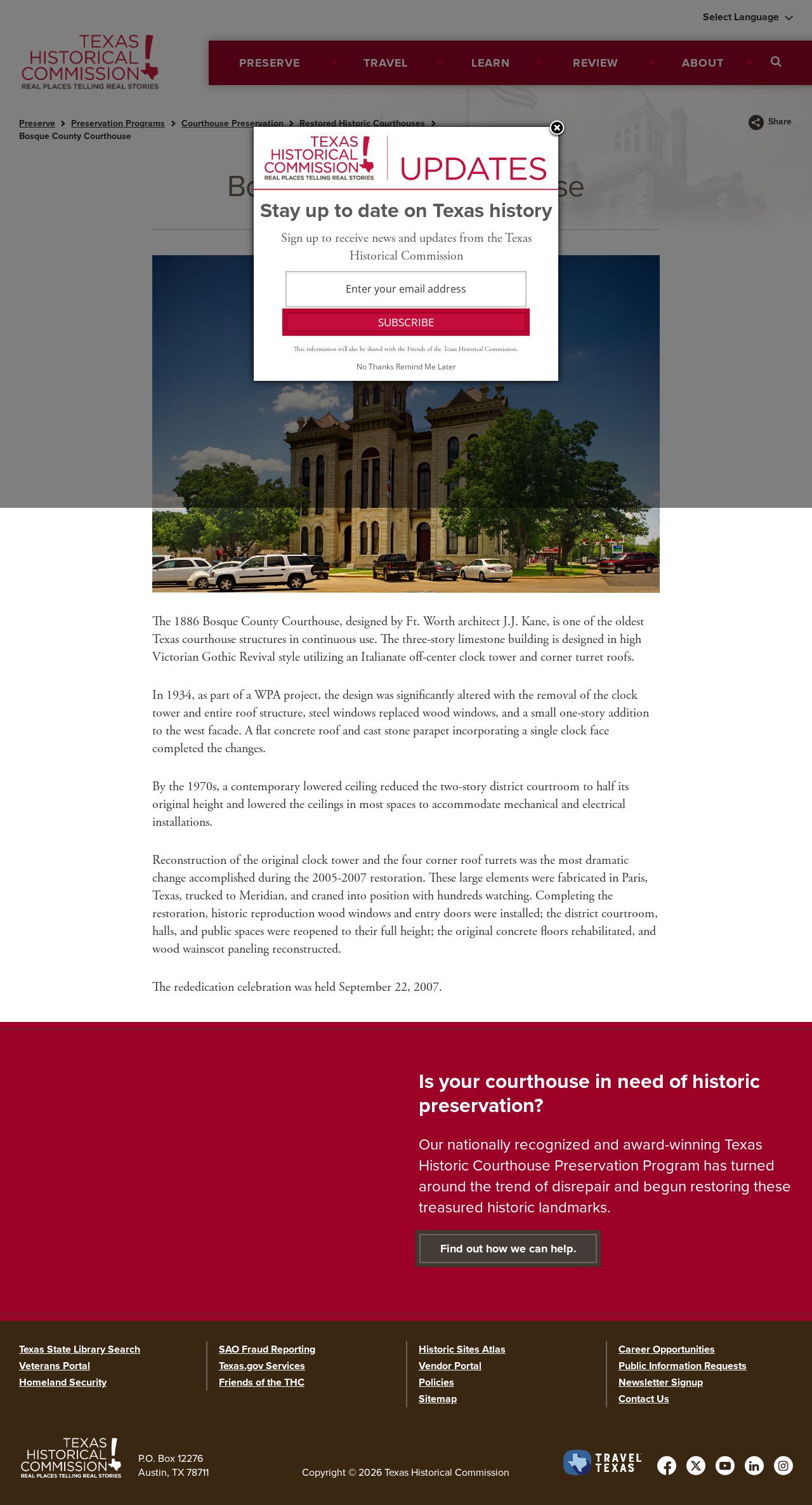
Today the District Clerk’s counter in Suite 209 remains the practical starting point for a felony case file, while some County Court at Law work occurs at the Judicial Annex.
Bosque County Supervision Records
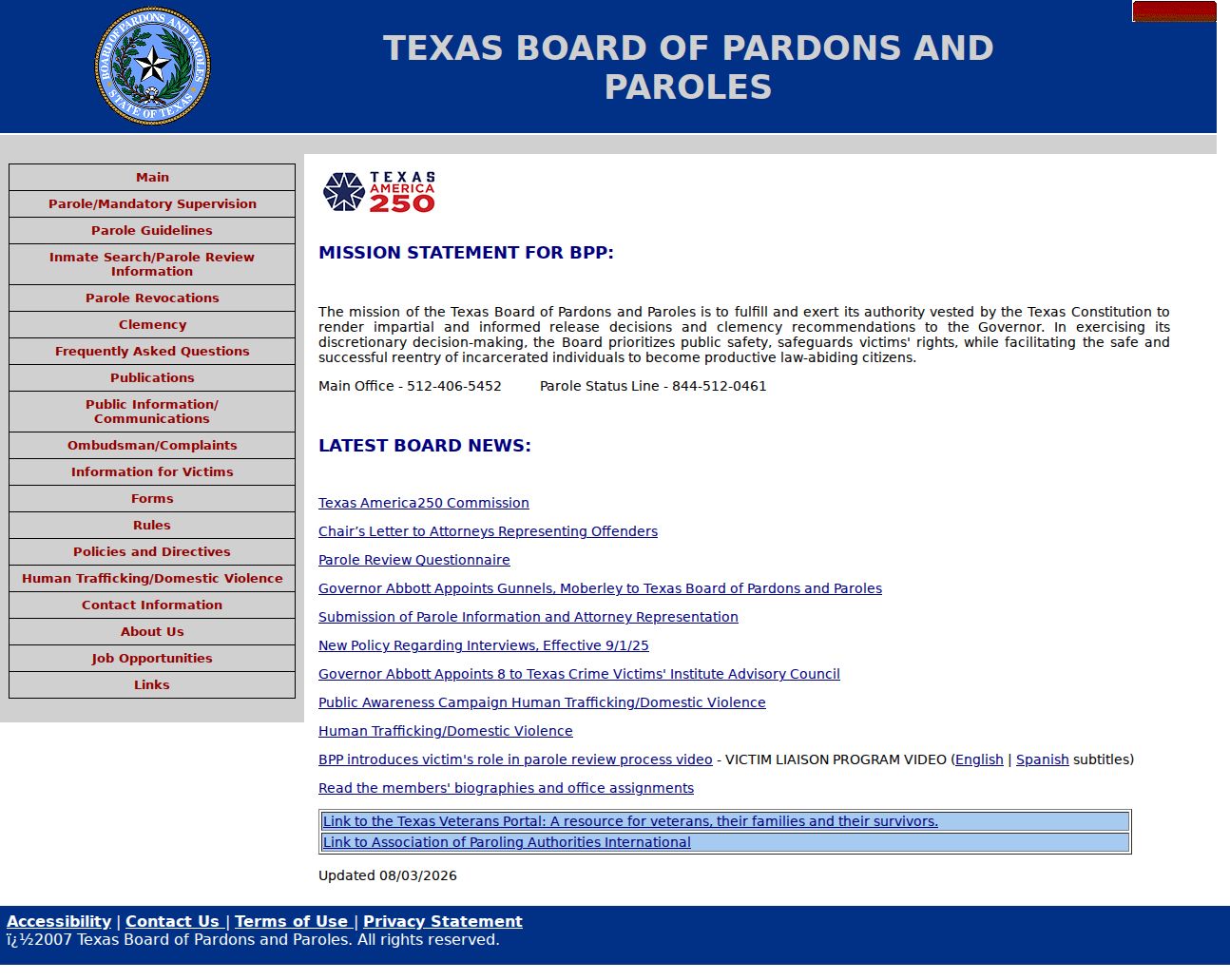
Community supervision, often called probation, is administered locally by the 220th Judicial District Community Supervision and Corrections Department for Bosque, Comanche, and Hamilton Counties. Parole is state-run. The Texas Board of Pardons and Paroles makes release decisions, and the TDCJ Parole Division supervises releasees. Bosque County is assigned to the Waco District Parole Office in Region IV.
The Texas Board of Pardons and Paroles publishes official status and contact information.
For notice of a custody or parole status change, Texas also operates the free Integrated Victim Services System.
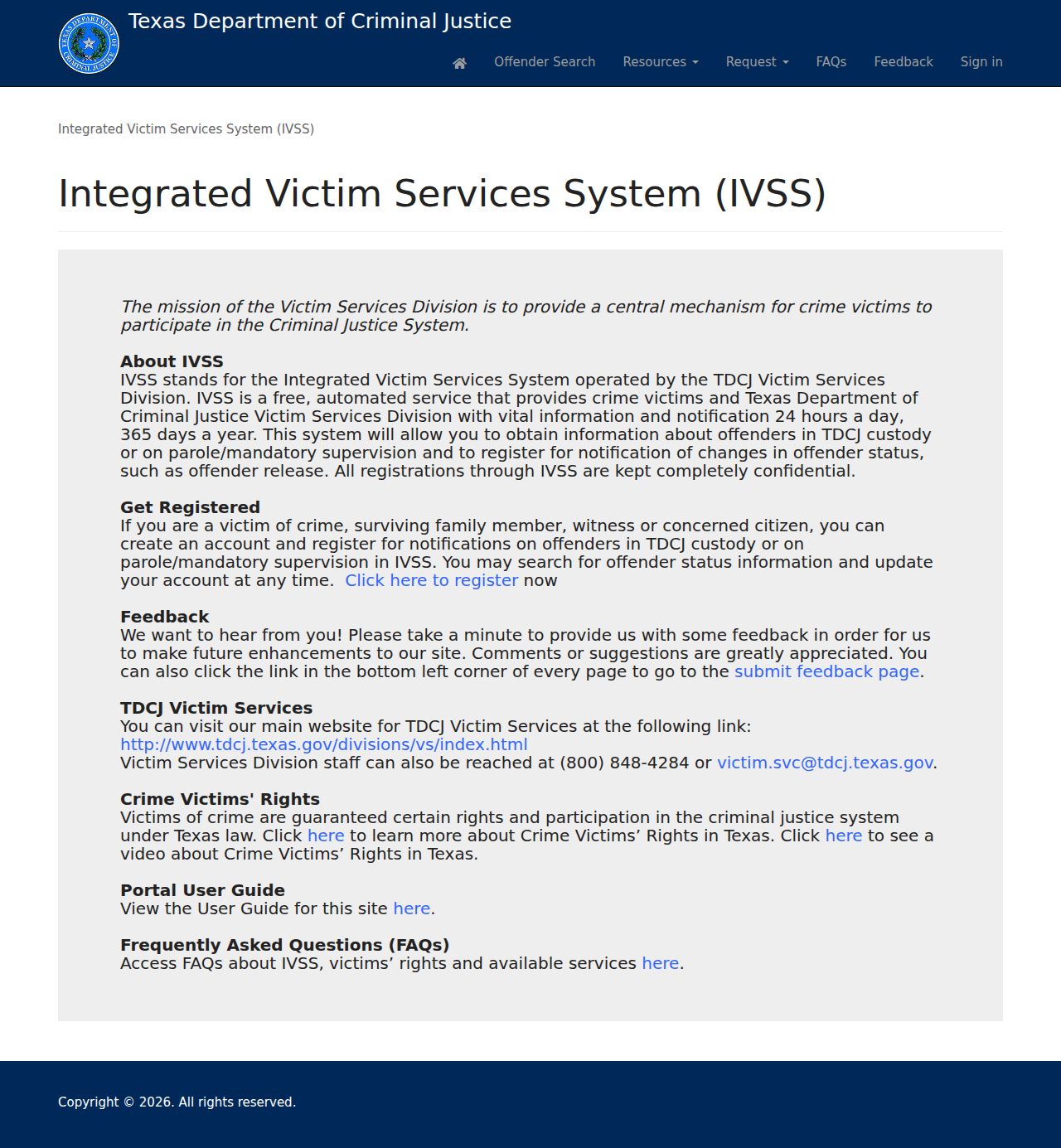
These state systems begin after the local court and custody stages; they do not hold the full Bosque County court file.
Criminal Records by City in Bosque County
City police write their own incident and arrest reports, and municipal courts handle only matters within their jurisdiction. Clifton has a police records form and a court limited to Clifton Police and Code Enforcement cases. Meridian routes police requests through city administration and warns that online payment may enter a guilty result. Valley Mills uses an open-record form sent to the city administrator. County custody questions still go to Bosque Booking.
The Clifton Police Department publishes its local contact and records route.
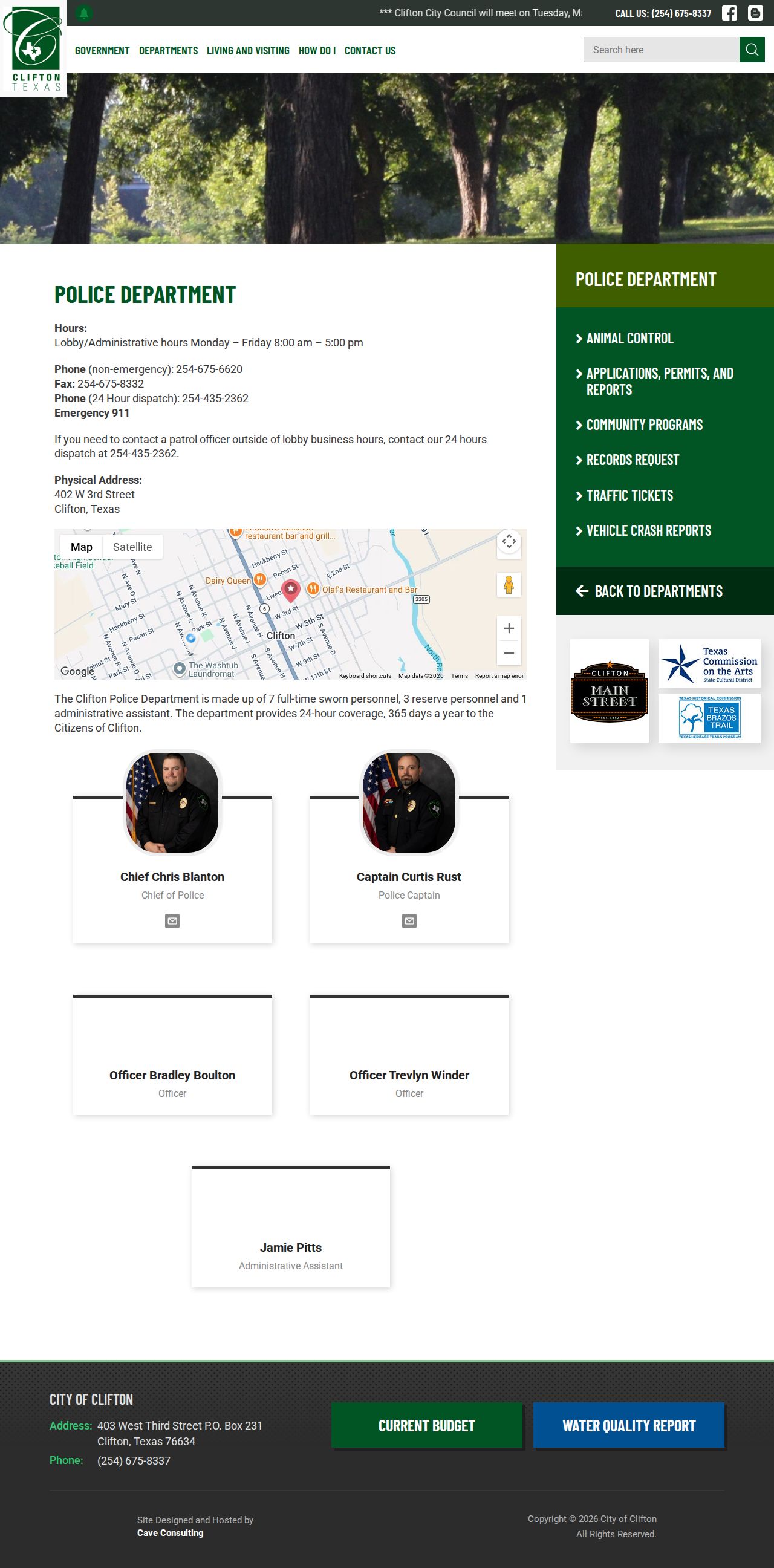
That city source belongs at the start of a Clifton police-report request, before the county and state layers.
The Clifton Municipal Court page identifies its citation and court procedures.
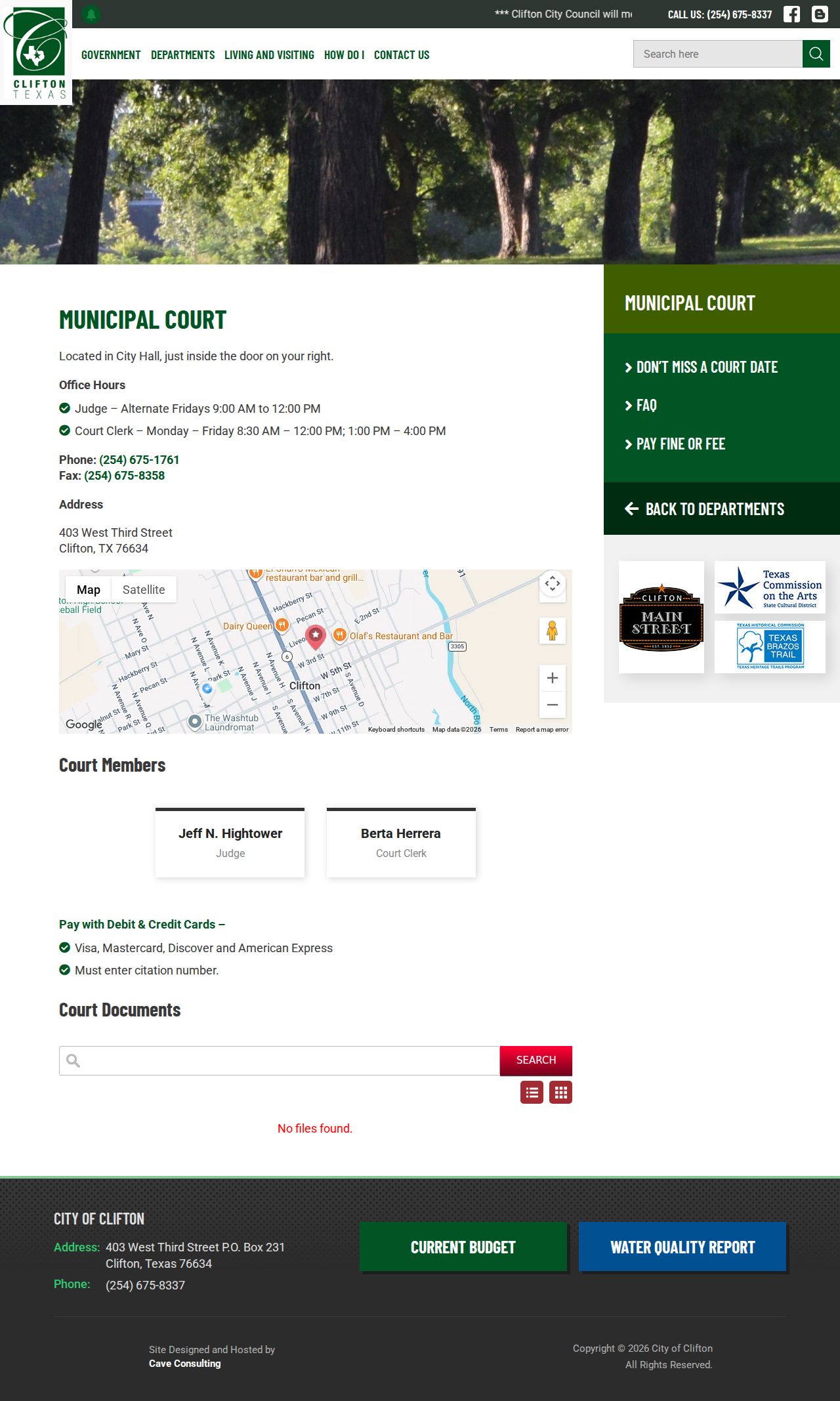
The court handles Clifton Police and Code Enforcement matters, not every citation issued near Clifton.
The Valley Mills Police page supplies that city’s incident-report contact.
Valley Mills requests then move through the city administrator’s open-record channel, while custody checks move to the county jail.
Clifton Criminal History
3,465 residents in 2020 · Police form, city court, and county booking routes
Meridian Criminal History
1,396 residents in 2020 · City request channel and municipal court cautions
Valley Mills Criminal History
1,229 residents in 2020 · Police, city records, and citation procedures
Bosque County Criminal Record Context
Bosque County spans about 983 square miles and had an estimated 18,918 residents in 2025. Meridian is the county seat, yet many people first meet the justice system at a city police department, one of two justice courts, or the 64-bed jail. State highways connect widely spaced communities. This small-county structure makes correct routing more useful than a broad name search.
The county’s official history describes its formation, geography, and seat.
DPS submission counts are reporting measures, not a crime rate. Differences among Clifton, Meridian, and Valley Mills can reflect reporting, fingerprints, offense mix, or timing. They should never be used to label one community as safer or more dangerous.